
Online Booking: from dated widget to AI-assisted revenue system
A multi-year product story about rebuilding Housecall Pro Online Booking from a slow, non-responsive tool into a scalable booking system, then evolving it through research, activation, optimization, and AI-assisted setup.
Role: Product Designer → Senior Product Designer · Company: Housecall Pro (field-service SaaS) · Timespan: 2022 to present
Domain: Online Booking for home service businesses, across the Pro configuring it and the homeowner booking through it.
TL;DR
- What it is: A 24/7 booking channel that connects a business's setup with the homeowner experience.
- What changed: We replaced a slow, non-responsive product with a faster, fully responsive system, then expanded its settings, onboarding, payments, lead intake, discovery, and optimization.
- Why it matters: Receiving a first booking within 30 days correlates with stronger customer retention, making setup and activation part of the revenue model.
- My role: I worked across both sides of the system, moving from hands-on flow design to research-led product decisions, shared patterns, data analysis, and AI-assisted setup.
Impact snapshot
A few signals from the product's scale, measurement work, and roadmap impact.
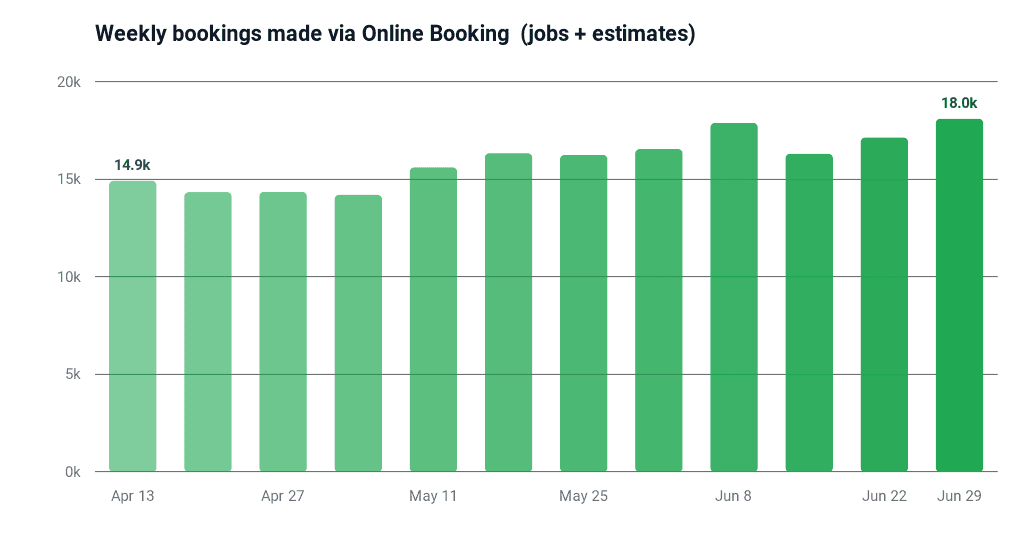
18k/week
Bookings and estimates through Online Booking
~70k+/month
Monthly booking volume
6% → 19%
Corrected homeowner conversion baseline after filtering bot traffic
4+ years
Designing Online Booking end to end across Pro setup and homeowner booking
Product evolution
2022 to 2023: Rebuild and foundations
When I joined, Online Booking was slow, non-responsive, missing key capabilities, and difficult for Pros to configure. We had extensive feedback but needed a clear direction.
I combined Pro research, session replays, and a review of the booking market to help define a replacement. We rebuilt the product from scratch and gradually retired the old version.
My work covered the responsive homeowner flow, Pro setup, onboarding, and smaller high-leverage fixes. One replay showed Pros missing the live preview, so we made it visible and clearly labelled by default.
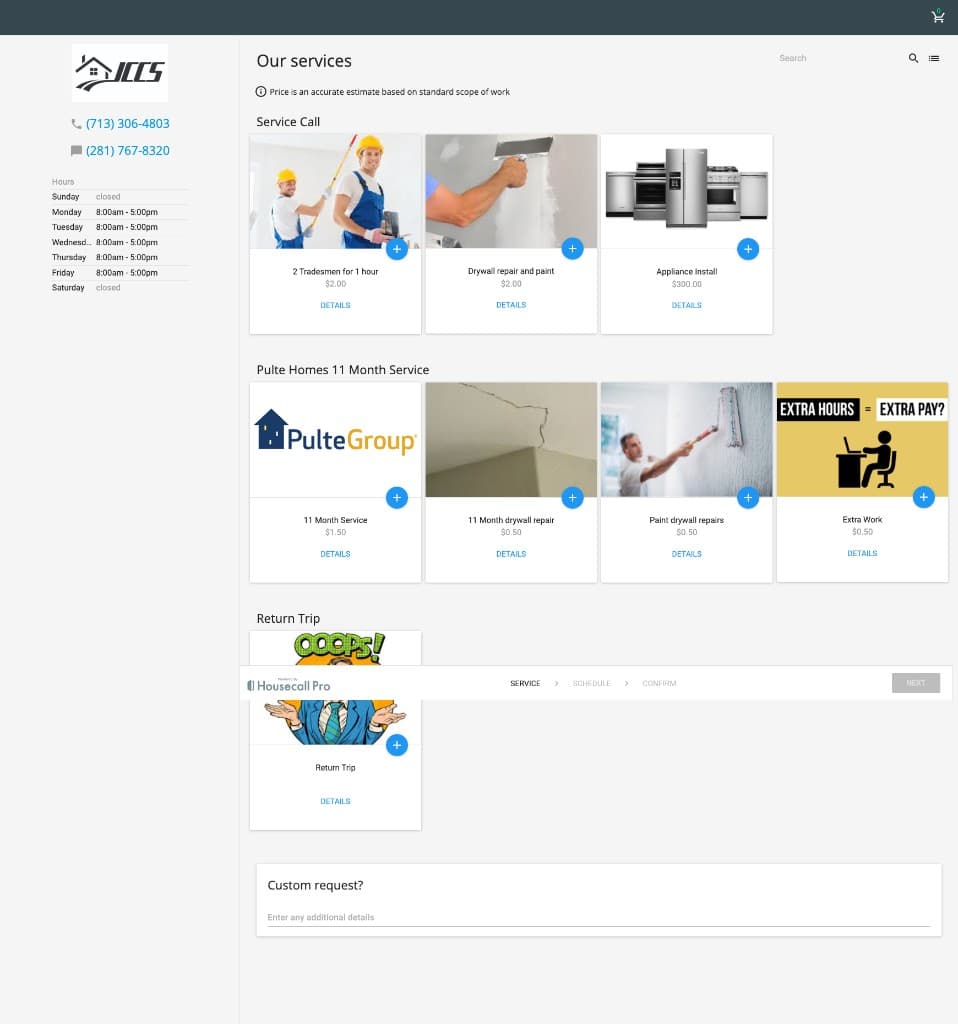
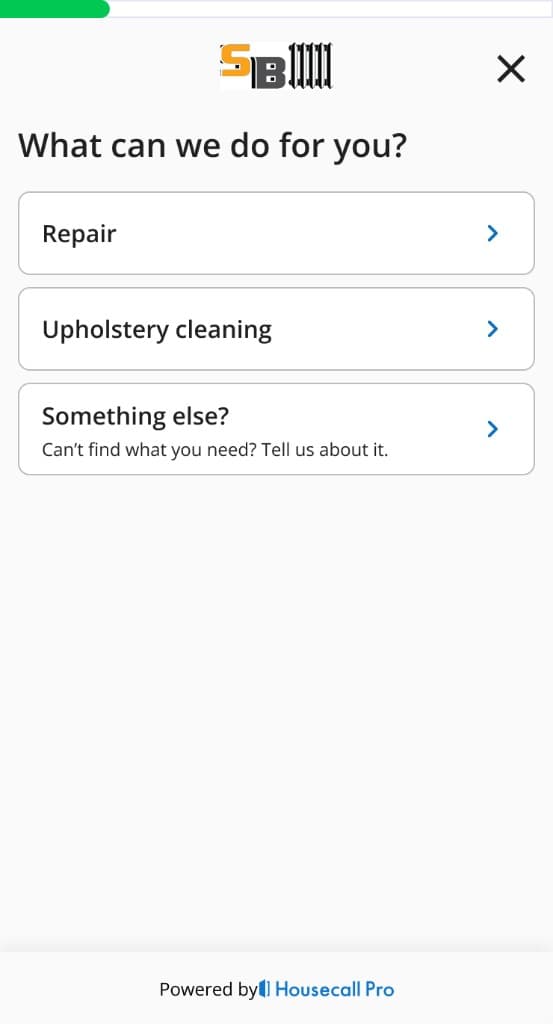
The result was a faster, fully responsive foundation that the team could extend without working around the constraints of the original product.
2024: Research-led expansion
Once the foundation was stable, the challenge shifted from rebuilding to deciding what belonged on the roadmap.
I ran surveys and interviews to test demand and understand tradeoffs:
- Contacted around 200 Pros to get about 30 quality responses defining what makes a useful lead.
- Researched card-on-file, deposits, and no-payment flows, finding that fewer no-shows could come at the cost of conversion.
- Validated coupons as a highly requested capability.
- Partnered with Payments and other teams to integrate shared capabilities without fragmenting the booking experience.
This work moved my role from receiving feature briefs to helping create them with evidence.
2025: Systemization and discovery
As Online Booking expanded, point solutions made settings harder to navigate and maintain. Some Pros also missed the feature entirely.
I redesigned settings around a new data architecture and a reusable card-based pattern. I also explored recommendations, predefined services, and smart defaults to reduce setup effort.
Working with Design Systems, Payments, and other teams, I created shared components and contextual entry points across Customers, Leads, and Jobs. The goal was a coherent system, not another set of isolated screens.
2026: Activation, optimization, and AI
The current focus is activation: helping more organizations configure Online Booking and receive a first job within 30 days.
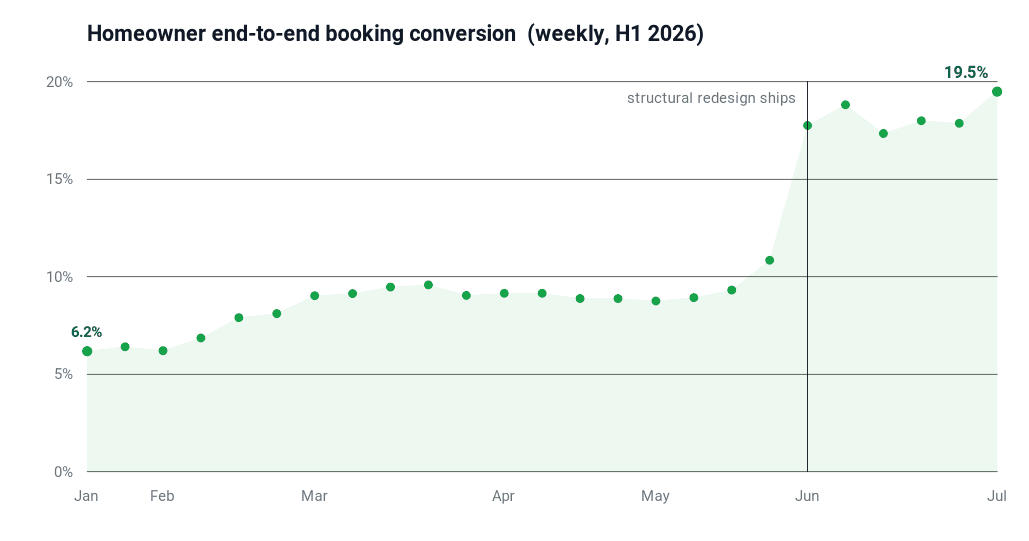
I conducted a competitive teardown and ran A/B tests across categories, contact collection, and service details. Most tests moved conversion very little. Instead of forcing a design success story, we questioned the measurement.
We found that bot traffic was inflating the funnel denominator. Filtering it out changed the reported conversion baseline from roughly 6% to 19%. The useful outcome was a more accurate baseline for future experiments.
In parallel, I explored two ways to move beyond conventional funnel optimization:
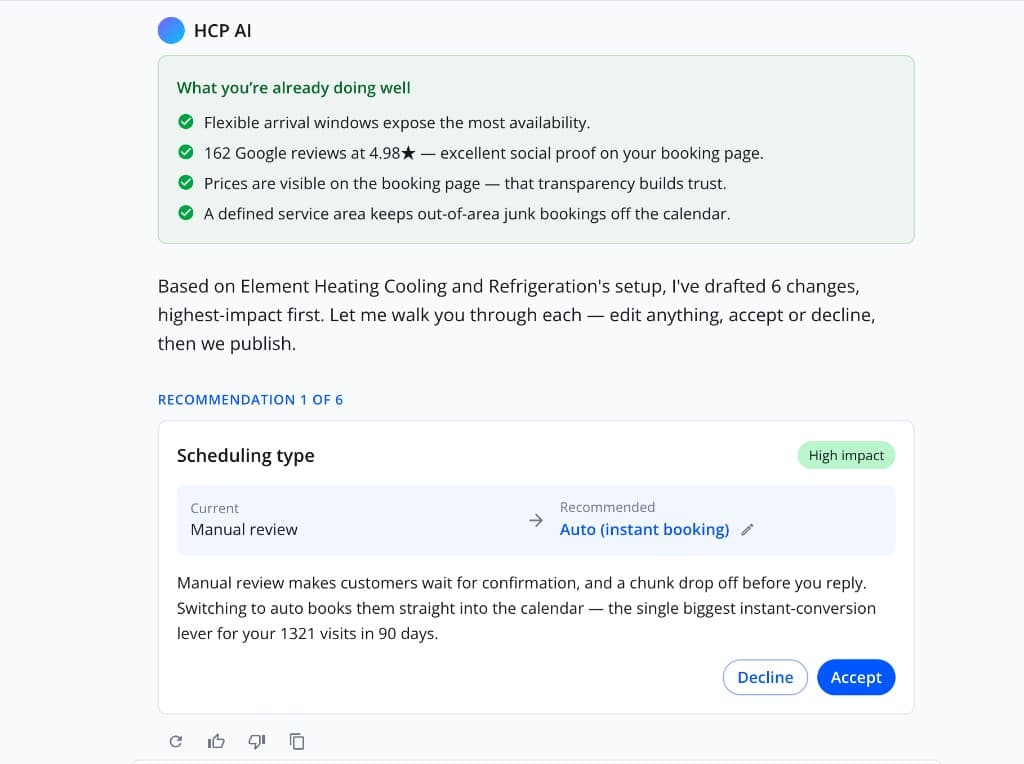
Interactive prototype
A dynamic prototype with multiple scenarios. See how the recommendation system responds to different booking configurations.
Open prototypeRead the AI Booking Agent case study →
- AI-assisted setup: I analyzed 1,500+ customer-feedback snippets to define recommendations across booking hours, services, deposits, and arrival-window length. The core insight was that configuration, not a lack of features, is often the bottleneck.
- Book other service: I designed a path that routes unmatched demand as a lead instead of ending the homeowner journey.
Why this matters for AI agent work
Online Booking is not one flow. It is a connected system of decisions across services, availability, payments, service areas, lead intake, booking rules, and conversion.
That complexity made it a natural foundation for AI-assisted setup. An assistant can inspect a business's configuration, identify gaps, explain tradeoffs, and recommend changes. The Pro remains in control, reviewing and approving each action before anything changes.
This is the kind of agentic workflow I am interested in designing: AI operating inside a real product system, using domain context to reduce complexity while keeping consequential decisions understandable and human-controlled.
How I work
Observe behavior
Session replays reveal real friction.
Talk to users
Research shaped roadmap decisions.
Design systems
Shared patterns scale better than isolated screens.
Question metrics
A polished experiment is useless if the baseline is wrong.
Use AI for decisions
Help people configure the right system, not just add more features.